Meet Global Partners of ECRA: Assoc. Prof. Dr. Laura-Anca Parepa on China and Eurasia, Cybersecurity, Defence Technology, and Academic Mobility

This interview is conducted under the special rubric “Meet Global Partners” of the Eurasian Continent Research Association. Ms. Paeton Romero, intern at the CECPSR, Armenia, and student at Stonehill College, Class of 2029, interviews our distinguished member, Assoc. Prof. Dr. Laura-Anca Parepa, Doshisha University.
- What drove you to focus your research on China’s role in the Eurasian Continent?
My long-time interest in Asian cultures and civilizations was influenced by my family background and professional experience. Because my father was a Sinologist, I became familiar with Chinese culture and civilization from a young age. I also had a chance to live and study in China and later to work with Chinese partners, which allowed me to gain a deep understanding of the country and its role in the wider Eurasian region. In addition, before joining the academic field, I had the opportunity to work on projects related to different Asian countries. These professional experiences provided me with first-hand knowledge regarding the military and political dynamics across the region. They helped me to develop a nuanced understanding of security concerns, historical legacies, and geopolitical rivalries in the region. Because of all these experiences, I decided to conduct a significant part of my research on China’s growing influence and connections throughout the Eurasian continent.
- As a speaker of the Eurasian Research on Modern China and Eurasia Conference, what is your experience in this conference, and why should others join? What makes this conference unique among so many international conferences around the world?
I think this conference is different from many others because it combines high-level international academic quality with an intellectual open atmosphere. It provides a good environment not only to present research and exchange ideas, but also to build professional relationships. Another point that I really appreciate is that it approaches the Eurasian region from different angles and perspectives and this makes it an excellent platform for anyone interested in this region. Such interdisciplinary is possible through the efforts of organizers to bring together scholars, experts, and practitioners working on a broad range of topics related to Eurasia. In addition, the conference creates a good environment for open and constructive discussions, which often leads to new research perspectives and academic collaborations. I also believe that is a valuable space for young researchers as it gives them a chance to interact directly with established scholars and get constructive feedback on their work.
- You have an interesting career trajectory from Romania to Japan. Please tell us more about it and advise how mobility can be helpful in a scholar’s career. Please tell us about the difference between doing research in these 2 countries.
Before joining academia, I worked in defense cooperation and diplomacy, so my career trajectory has been significantly shaped by international mobility. This experience offered me significant opportunities to engage with different countries and institutional environments. More importantly, this mobility has been essential for my later development as a researcher, because it has allowed me to observe political and security situations from multiple angles, access diverse sources of information and compare different policy approaches in practice. I believe that in academic settings, international mobility is also extremely valuable, as it helps scholars to learn about different intellectual traditions, methodologies and academic expectations. But more importantly, it helps them to improve their adaptability, to broaden their perspectives and deepen their comparative understanding, which is essential for a scholar’s development. However, I should note that I do not have research experience in Romania, so I am not in a position to make a comparison between the Japanese and Romanian academic environments.
- Why did you decide to join the Eurasian Continent Research Association? What is your advice to other scholars? What can they find in this association?
I study China and its relations with different countries across the region, so it was a natural choice to join this association. Actually, I was very glad when I came across the conferences organized by Dr. Sahakyan, as I had been looking for an Eurasian-focused academic environment for a long time. Another reason for joining the association is represented by the collective approach to knowledge production. In my opinion, this association is about collaboration and open discussions. What makes it a great environment is that instead of treating research as an individual effort alone, it brings together different perspectives, facilitating a complex understanding of regional situation within an academic framework. Working with colleagues with different backgrounds improves the quality and depth of scholarship while ensuring that analytical insights are based on rigorous academic standards.
- Based on your speech during the VI Eurasian Research on Modern China and Eurasia conference about the Defence-Technology partnerships in Eurasian continent, how does states’ use of defence technology partnerships transform traditional geopolitical alignments in Eurasia, and in what ways does this differ from earlier models of military cooperation?
One of the key points of my talk was that defense-technology partnerships are changing existing alignments in Eurasia. As a result, traditionally rigid and alliance-based structures are slowly eroded and replaced by relationships characterized by flexibility and asymmetry. Nowadays, defense-technological cooperation is becoming modular and integrated in broader economic and industrial ties. This happens because formal alignment or alliance commitments are losing their significance as frameworks for strategic cooperation. As a result, many states choose to engage in selective partnerships based on their capability requirements, affordability of the offers, and political flexibility. In this context, China plays an important role because it offers those who are interested in working together not only platforms and equipment but also training, financing and industrial cooperation. This results in what I would call asymmetric embeddedness which means that states can gain access to capabilities they need but gradually become integrated into Chinese technological and logistical ecosystems. Of course, existing alignments are not replaced overnight, especially those with Russia, but they are gradually reshaped by increasing diversification and reducing dependency on a single supplier. Therefore, the main distinction from previous military cooperation models is the lack of bloc logic. We can see layered and overlapping partnerships in which states simultaneously maintain ties with China, Russia and Western actors, rather than a clear-cut alignment or non-alignment. Thus, I will say that geopolitical alignments in Eurasia are becoming more fluid and fragmented. Smaller and medium states gain greater room for maneuver and can diversify their strategic choices, but they also enter into new forms of dependency that are less visible than traditional alliance structures but potentially just as significant in the long term.
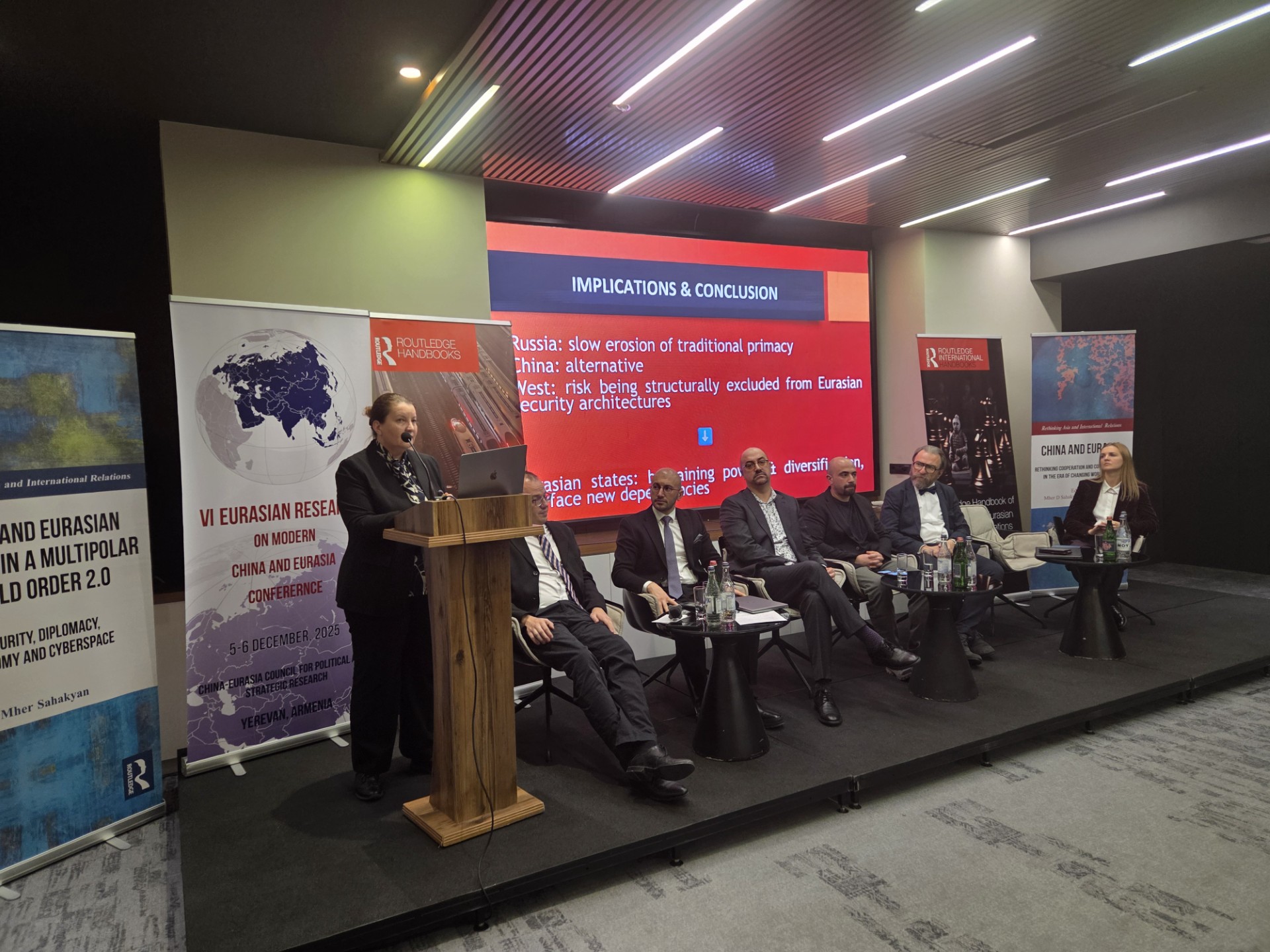
Assoc. Prof. Dr. Laura-Anca Parepa delivers a speech during the VII Eurasian Research on Modern China and Eurasia Conference organised by the China-Eurasia Council for Political and Strategic Research, December 5-6, 2025. From left to right: Dr. Maximilian Ohle, Dr. Ahmet Faruk Isik, Assoc. Prof. Dr. Rubén Ruiz Ramas, Mr. Archil Sikharulidze, Prof. Dr. Habil. Marcin Składanowski, and Dr. Ksenia Radchenkova.
- To what degree do China and the US’ defense technology partnership or competition with Japan or other states promote strategic autonomy or deepen dependency, and how should policymakers respond?
The impact of defense-technology cooperation on the strategic autonomy of partner countries depends largely on the conditions of these partnerships. In general, defense-technology cooperation goes beyond the transfers of equipment and weaponry. It includes software, maintenance, training, data integration and many other less visible items. Thus, if a partner state buys from China or the US only systems, but relies on foreign maintenance, data, software, production and so on, such partnership will deepen the dependency. However, when these partnerships include the transfers of technology, skills or production capacity to the partner country it can foster a certain degree of autonomy. In this situation the partner state might be able to create jobs, gain access to advanced technology and develop their own industrial capacity.
The competitive dynamics between China and the US and between each of them and actors, can give rise to a complex situation in which those pursuing defense-technology cooperation with one of them might be limited or restricted from engaging with the other. Actually, we can observe that both the US and China are trying to tie their partners in their defense-technological ecosystems. However, this situation brings some opportunities for other actors, such as Japan, the UK, the EU, or Canada. An opportunity to improve and develop their own potential by investing in domestic industrial capacity, as well as through joint partnerships. We can see some timid steps in this sense, but the potential for development is really high.
For policymakers it is unrealistic to believe that it is possible to fully eliminate dependency in the defense-technological domain. The challenge is rather how to manage such dependency in a strategic way. I think a good modality is to balance between diversifying suppliers, maintaining interoperability when necessary and avoiding over-reliance on a single technological ecosystem. One more important aspect that is worth mentioning is investing in domestic research and development of defense industrial base. Lastly, when choosing partners, policymakers should evaluate not only the economic or technical dimensions of partnerships, but also their long-term strategic and political implications.
- Japan announced about rebuilding its military production and modernizing its armed forces. What kind of impact will it have on the balance of powers in Eurasian continent?
The recent decisions of Japan concerning the modernization of its Self-Defense Forces, military production and export policy changes can be understood as a natural response to the current international environment, which is characterized by growing uncertainty and intensifying great-power competition. Regarding the impact on the balance of power in the broader Eurasian space, in my opinion this evolution contributes to a more multipolar security order. It can be seen as a reflection of a wider process of strategic rebalancing among major players, rather than a development that brings destabilizing effects to the region. In this sense, I believe that a more robust Japan can contribute to a balanced distribution of power in Eurasia, reducing the risk of excessive power-concentration by any single state. At the same time, it can also increase the strategic alternatives for smaller and middle states. As defense-technology cooperation will diversify, states will seek to reduce reliance on one dominant supplier and will be able to engage into more flexible patterns of cooperation and hedging. Overall, I think that Japan’s transition into a more engaged security player can contribute to a more pluralistic security environment in which smaller states can gain strategic room for maneuver. Nevertheless, we cannot neglect that such evolution adds a new element of complexity to the already competitive regional order and will require careful management of escalation risks.
- Based on your edited book Statecraft and Governance in Cyberspace, how are states using cyberspace as a tool for power and competition, and what challenges does this create for global rules, cooperation, and society?
First, I would like to mention that this edited volume is a collaborative work that brings together contributions of fourteen scholars from around the world.
Regarding the use of cyberspace for power and competition by states, there are three aspects that I would like to mention: First, states are using digital infrastructure, platforms, AI and data flows to increase their geopolitical influence. They are transforming the control over networks, information and connectivity into influence and leverage, an aspect that allows them to project power easily without using economic means or military force. Second, states are using their capabilities in cyberspace for traditional security purposes. This can include defense and deterrence, but also espionage, coercion and disruption created to the adversary. Third, states are increasingly treating the governance of cyberspace as an extension of geopolitical strategy, thus a form of statecraft. By promoting rules, technical standards and norms, states can define what represents responsible behavior in cyberspace and promote governance models that fit their own strategic interests.
Such developments bring challenges for cooperation and global norms. As competition between states moves into cyberspace, divergent visions of the global cyber order and disagreements over rules related to data sovereignty, information flows and the balance between security and human rights begin to emerge. These differences make the establishment of global rules more difficult. Cooperation is further complicated by the fact that non-state actors, such as private corporations, control critical infrastructure, key networks and data flows. One result is that states have to negotiate and even compete with these actors, an aspect that hinders the efforts to build cooperative frameworks and shared norms. The social implications of these developments cannot be neglected. Societies and individuals are directly affected by cyber competition, fragmentation of global governance and lack of commonly accepted rules. They become more vulnerable to cyberattacks, disinformation, algorithmic manipulation, surveillance and data exploitation. In the long-term, all these risks can give rise to human rights abuses, undermine privacy, accountability, and democratic debate.

Interview conducted by Paeton Romero, intern at the CECPSR, Armenia, and student at Stonehill College, Class of 2029.

For more information about the Eurasian Continent Research Association, please visit the Association’s official page